SMS and voice MFA retirement in Entra ID: what admins need to check now
ID Posture Team · 16/11/2026
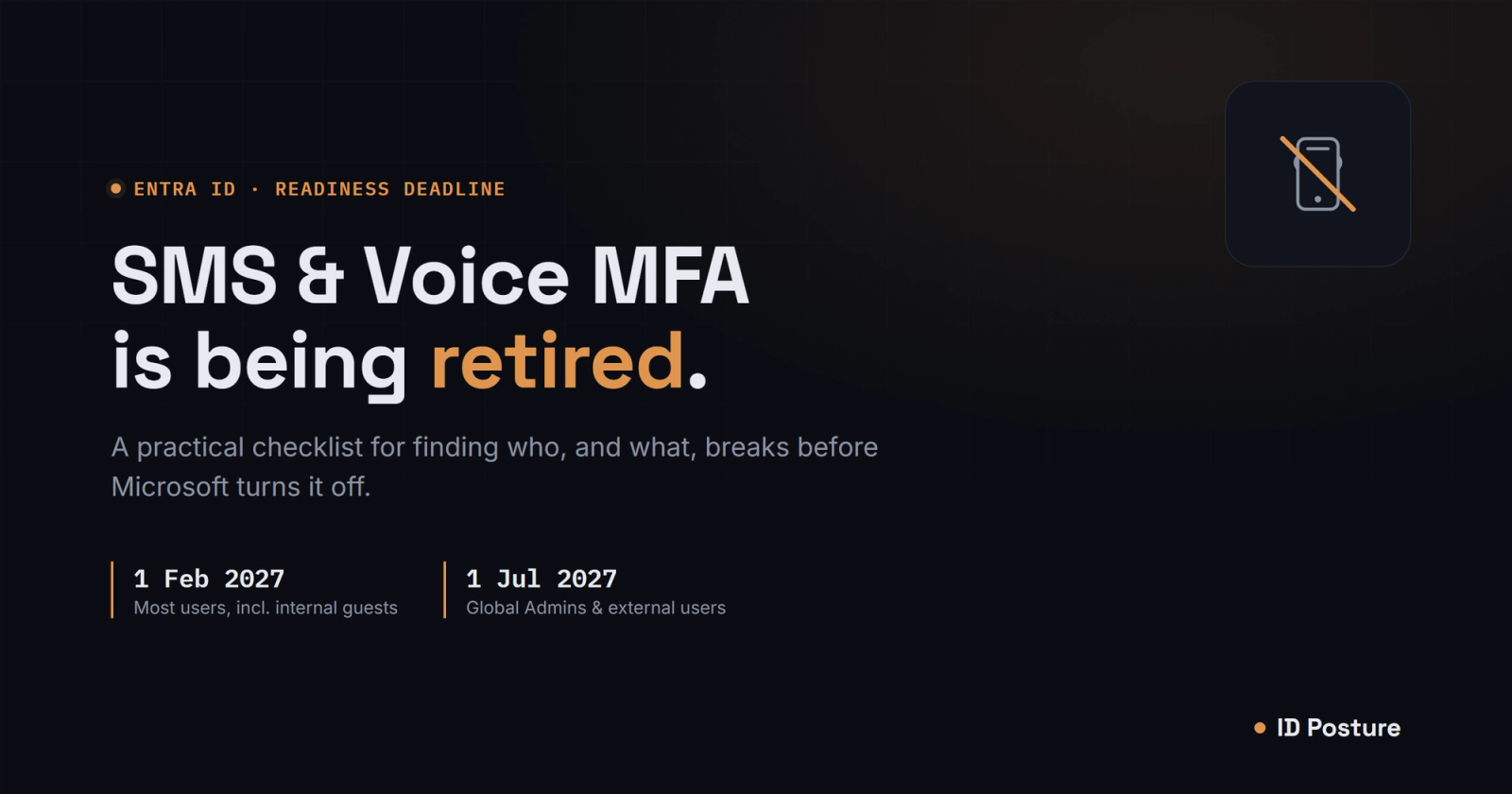
Microsoft is retiring its own SMS and voice sign-in for Entra ID, in both the public cloud and GCC. Retirement starts rolling out from 1 February 2027 for most users, including internal guests, and from 1 July 2027 for Global Administrators and external users. Microsoft has not published a per-tenant schedule, so 1 February 2027 is the date to plan against, not a soft starting point you can wait out.
This is not just an MFA prompt disappearing quietly. Once retirement reaches your tenant, a user whose only registered method is SMS or voice will be forced to register a passkey before they can finish signing in. Self-service password reset, custom authentication strength policies, and NPS-protected VPN or Remote Desktop Gateway access all have their own separate exposure, and none of them get fixed just because sign-in itself keeps working. This post is a practical checklist for finding exactly who and what is affected in your own tenant, and what will not show up in Entra ID's own reporting at all.
What is actually changing
- Microsoft-provided SMS and voice sign-in retires from 1 February 2027 for most users (including internal guests), and 1 July 2027 for Global Administrators and external users.
- After retirement reaches your tenant, there is a 50-day grace period for self-service password reset specifically. After that, phone-based methods stop counting as SSPR-qualifying methods, independently of the sign-in change above.
- A custom authentication strength policy that allows SMS or voice but does not include a passkey (FIDO2) will keep an affected user locked out, not just prompted.
- NPS and RADIUS, used for VPN and Remote Desktop Gateway access, also lose SMS and voice support, and NPS has no passkey equivalent at all.
- Tenants that have already moved to their own telephony provider through Microsoft Security Store are not affected by the sign-in block.
Source: Microsoft's SMS and voice retirement experience guide and the retirement concept overview.
Who actually gets blocked, and why a passkey alone might not be enough
Once retirement reaches a user whose only registered method is SMS or voice, Entra ID forces them to register a passkey before they can complete sign-in. In that narrow sense, sign-in mostly fixes itself. The gap is everything else that depends on a phone-based method but is not part of that forced prompt.
Self-service password reset is the clearest example. SSPR has its own separate list of qualifying methods, and phone-based methods drop out of that list 50 days after retirement reaches your tenant, on their own timeline. A user can have a brand new passkey and still be unable to reset their own password, if a passkey is the only thing they registered and they later lose the device it lives on, because nothing prompts them to add a second, non-phone SSPR method the way sign-in prompts them to add a passkey.
Admins are the other case worth calling out specifically. Global Administrators get the later deadline, 1 July 2027, but that is not a reason to leave them until last. Admin accounts are the highest-value target in the tenant regardless of which date applies to them.
ID Posture's Member Identity checks already flag accounts with no MFA registered at all, and accounts relying only on phishing-susceptible methods like SMS and voice, so you have a starting point for finding at-risk users without building a one-off audit.
Four things to check in your tenant today
- Who is only registered for SMS or voice. In the Entra admin centre, go to Protection > Authentication methods, and use the registration details report, filtered by method.
- Who is SSPR-registered with only phone-based methods. The same registration report shows SSPR-qualifying methods separately from sign-in methods, check both.
- Whether any custom authentication strength policy allows SMS or voice without allowing a passkey, and whether an active Conditional Access policy actually references it. A blocking policy nobody enforces is a lower priority than one three Conditional Access policies depend on.
- Whether the passkey (FIDO2) method is actually enabled tenant-wide, not just for a pilot group, and whether it reaches the same users flagged in step 1.
What will not show up in this review
None of the reporting above tells you anything about NPS or RADIUS. VPN and Remote Desktop Gateway access that depends on the NPS extension is a separate code path with no passkey support at all, and it is invisible to Entra ID's own sign-in and registration reports. A clean sign-in test in a browser proves nothing about whether NPS-protected access still works. If you use the NPS extension for VPN or RD Gateway, that needs its own conversation with whoever manages that infrastructure, well before 1 February 2027.
A realistic order to work through this
Start with anyone who depends on NPS or RADIUS. They do not get a later deadline cushion that actually helps them, since NPS has no passkey path to fall back on at all. Then prioritise admins and other privileged accounts, even though most of them technically have until 1 July 2027. Then work through everyone else flagged as SMS or voice only. Aim to be finished well ahead of 1 February 2027: Microsoft has not published exact per-tenant rollout timing, so there is no reliable way to know how much runway any individual tenant actually has left.
None of this needs to wait for a dedicated project. Most of it is a registration report, a policy review, and one conversation with whoever runs your VPN. The part that usually takes longest is getting users to actually register something new, so the earlier that starts, the better.
ID Posture scans Entra ID nightly and already flags accounts with no MFA and accounts relying only on SMS or voice, alongside dozens of other identity findings, scored and tracked over time.
Frequently asked questions
When exactly will SMS and voice MFA stop working in my tenant?
Microsoft has not published a per-tenant rollout schedule. Retirement of Microsoft-provided SMS and voice sign-in begins rolling out from 1 February 2027 for most users, including internal guests, and from 1 July 2027 for Global Administrators and external users. Treat 1 February 2027 as your real deadline rather than waiting for a tenant-specific date.
Does registering a passkey fix everything?
It fixes sign-in. It does not automatically fix self-service password reset, which has its own separate list of qualifying methods. Phone-based methods stop qualifying for SSPR 50 days after retirement reaches your tenant, independently of the sign-in change, so affected users also need a non-phone SSPR method registered.
What about VPN or Remote Desktop Gateway logins that use the NPS extension?
NPS and RADIUS also lose SMS and voice support, and NPS has no passkey equivalent at all. This is not visible in Entra ID's own reporting, so it needs a separate manual check with whoever manages your VPN or RD Gateway infrastructure. A working browser sign-in does not prove NPS-protected access still works.
Is Microsoft Authenticator affected by this change?
No. This retirement is specific to Microsoft-provided SMS text messages and voice calls. The Microsoft Authenticator app, FIDO2 security keys, and other passkey methods are not affected, and are exactly what Microsoft is pushing people toward.